
Introduction
Carpenter jobs New Zealand wide suit people who like timber work. They like building things that last. They finish each day with something real to show for it. Carpenters build houses, apartments, offices, and decks. They work in towns and cities across the country.
This guide explains real carpentry work in New Zealand. You will learn what employers look for. You will also see where to find real listings and how to apply safely. Job seekers can use it as a starting point. Still, it does not promise a job, a visa, or sponsorship.
What carpenter work in New Zealand actually looks like
In New Zealand, a carpenter works on a building site. The job changes as the building grows. One week, workers deliver timber to a bare slab. A few weeks later, the frame stands and the roof goes on. Then inside work begins. A carpenter who stays on one site for months watches the whole house take shape.
Carpentry work falls into a few main kinds of roles. Framing carpenters build the timber frame of a house. They build walls, floors, and roof trusses. Finishing carpenters fit doors, windows, skirting, and stairs. They work on details people see every day. Formwork carpenters build timber moulds for concrete. Those moulds hold
concrete while it sets for foundations, walls, and floors. Renovation carpenters work on older houses. They fix, replace, and improve what already stands there.
A normal day on site
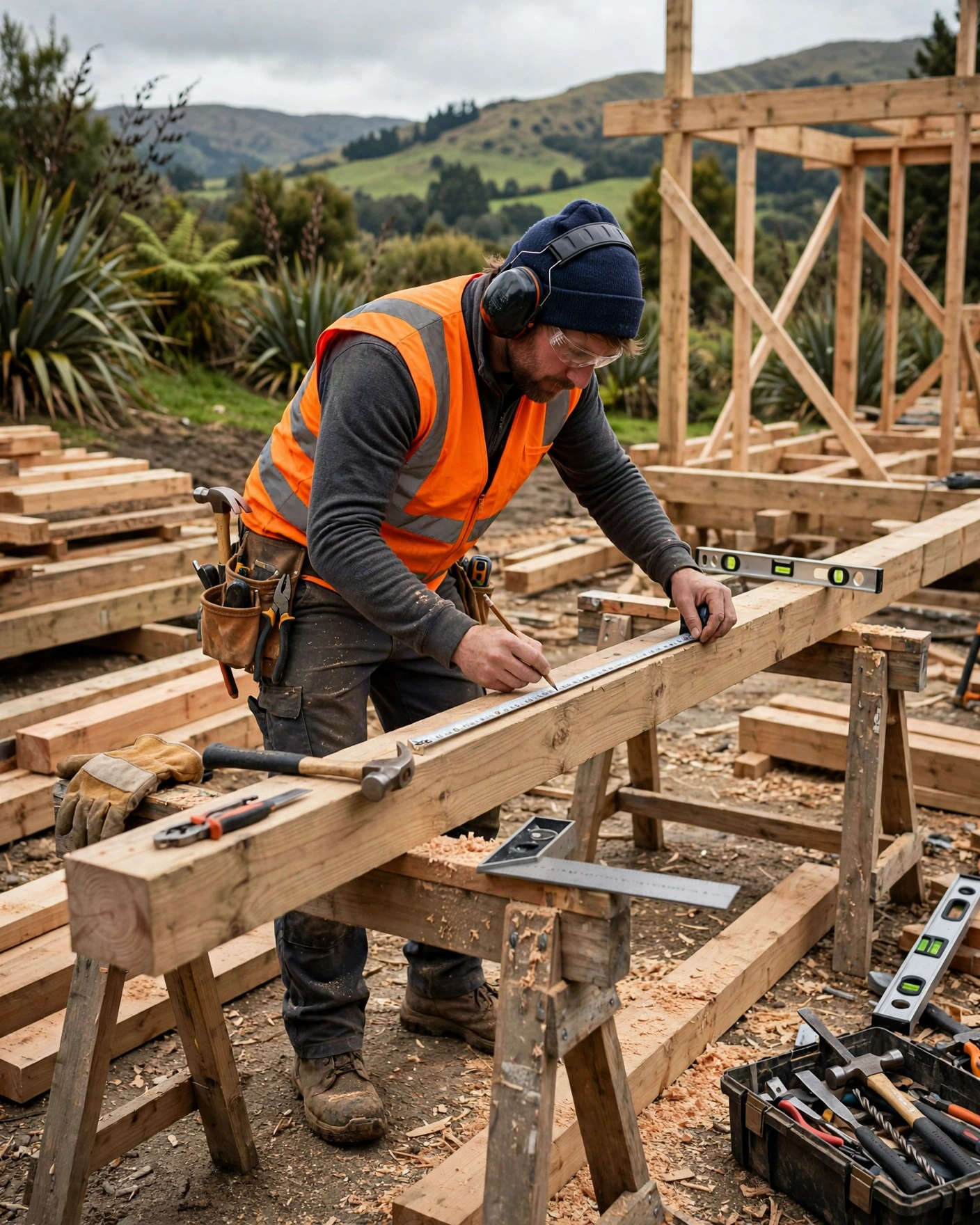
A normal day starts early, often at seven in the morning. Workers hold a short meeting first. They plan the work for the day and note the safety points to watch. Then the work begins. Carpenters measure, cut, and fix timber with hand tools and power tools. Next, they read plans and check levels. A square, straight frame matters, so they check it often. Other trades share the site too. Plumbers and electricians need the frame ready before they start their work.
The work is physical. It involves a lot of lifting, bending, and climbing. Carpenters work outside in rain, wind, and sun. They wear work boots, a hard hat, gloves, and a high visibility vest. Hours run to a full working week. Some jobs need early starts and Saturday work to stay on schedule. The work can be noisy and dusty. Workers wear ear protection and a dust mask when the job needs them.
The best carpenters measure twice and cut once. A square and level frame makes every later trade easier. A builder remembers a carpenter who takes care with the basics. That carpenter often gets the call when the next job starts. Carpentry is a trade. A carpenter who learns it well can work anywhere in the country.
Where to find real carpenter jobs in New Zealand
The best place to start is Seek New Zealand, which carries the most carpentry listings in the country. Search for carpenter, qualified carpenter, or hammer hand, and read the listing in full before you apply. Trade Me Jobs is the second place to check, and it often lists the same roles from building companies and recruitment agencies.
Building companies hire in every main centre, including Auckland, Hamilton, Wellington, Christchurch, and Dunedin, and in smaller towns where houses are being built. Large building companies list several roles at once, from apprentice to qualified carpenter, and they often have a careers page on their own website. Recruitment agencies that place carpenters are another way in, and they can be useful if you are new to the trade and want short term work first.
When you search, check where the site is and how far it is from your home. Some sites are outside the town centre, and some move from one place to another as the job changes, so travel matters. Check whether the listing says the role is full time, and whether it mentions a work vehicle, tools, or weekend work. A real listing names the firm, the region, and the kind of carpentry work involved.
Carpentry tickets and the Licensed Building Practitioner route, explained simply
Carpentry in New Zealand has a clear path, and it helps to know where you are on it. The first step is an apprenticeship, which takes about three to four years. An apprentice learns on site with a qualified carpenter, and studies at a polytechnic or through BCITO, the Building and Construction Industry Training Organisation. The apprentice finishes with a New Zealand Certificate in Carpentry, and that is the ticket most employers ask for.
A qualified carpenter can then work towards becoming a Licensed Building Practitioner, known as an LBP. An LBP is a carpenter who is licensed to carry out restricted building work, which is work that affects the structure or the weathertightness of a house. To become an LBP, a carpenter needs the qualification, several years of experience, and a record of the work they have done. The licence is issued by the Ministry of Business, Innovation and Employment, and it is checked by builders and by councils.
Health and safety is part of the job too. Many employers ask new workers to hold a Site Safe passport or to complete a basic health and safety course. The course covers the law, the common hazards on a site, and how to work safely around them. If a listing asks for a Site Safe card, check the Site Safe website for the current course, and never pay a large fee to a person who promises a card with no training.
If you trained overseas, check whether your qualification is recognised in New Zealand. The New Zealand Qualifications Authority can assess an overseas qualification, and BCITO can advise on what extra training is needed. A carpenter with overseas experience and a recognised qualification is much easier to place on a site.
What employers usually ask for
The main thing a building employer looks for is a carpenter who is skilled, reliable, and willing to learn. Experience counts, and a firm wants to see work you have done on a building site, with references from a past employer. A qualified carpenter with a New Zealand Certificate in Carpentry is the first choice for most firms, and an LBP is the first choice for work that needs a licence.
Employers look for people who can read plans and work from them. A carpenter who can look at a plan, measure the timber, and build the frame without being told every step is worth a lot to a builder. A clean driving record matters, because carpenters drive to sites and sometimes drive a work vehicle between sites, and the firm needs to trust you with the vehicle.
Trade training helps, but it is not always needed for a labourer role. Employers often ask for a Site Safe card, or for proof that you are working towards one. A worker who has finished a building course or holds a trade qualification can move into a carpentry role, and the pay and the work change with it.
Be honest about your experience, because a firm will find out quickly once you are on site. If you are new to carpentry, say so, and say what you can bring from your last job. Many carpenters start as hammer hands, learn the trade on site, and move on to a qualified role after a few years.
How pay is described in a listing
Pay for carpenter jobs in New Zealand is usually listed per hour, or as a yearly salary for a full time role. The rate changes by region, by the firm, and by your experience and tickets. A qualified carpenter earns more than a hammer hand, and an LBP earns more again. A real listing states the hourly rate clearly, or it says the rate is discussed at interview.
Read the listing for how pay is described. A listing that promises very high pay for very little work, with no firm name and no region, is a warning sign. Never pay for a job, a certificate from an unknown provider, a uniform, or a visa before you have a written offer. A real building firm pays you for your work, and it never asks you to pay to start work.
The visa question, honestly
Carpentry work in New Zealand is usually done by people who already have the right to work in New Zealand, such as citizens, residents, and people on work visas that allow trade work. The rules depend on your visa type, your age, and your experience.
If you are outside New Zealand and want to work as a carpenter, be careful with anyone who promises you a carpentry job and a visa for a fee. A real employer never asks you to pay for a job or a visa. Check the official immigration website for the visa you would need, and check that the employer and the firm are real before you send documents or pay anything.
How to apply, step by step
Step 1: Get your documents ready
Gather a short resume that lists your work experience, any carpentry training, and any tickets you hold, such as a Site Safe card or a New Zealand Certificate in Carpentry. Add references from a past employer if you have them. Have your work visa or proof of the right to work in New Zealand ready, and keep copies of any training certificates.
Step 2: Search Seek and Trade Me Jobs for carpenter jobs New Zealand wide
Search Seek New Zealand and Trade Me Jobs for carpenter, qualified carpenter, or hammer hand, and the region you want to work in. Read each listing in full. Check the firm name, the region, the kind of carpentry work, and whether the role is full time. Apply only to listings that name the employer and the firm.
Step 3: Write a short, specific application
Keep your resume to one or two pages. Put your carpentry experience at the top, and say clearly which region you can work in and when you can start. Mention the kind of carpentry you know best, such as framing, finishing, or formwork. Do not copy the job ad word for word.
Step 4: Prepare for a practical interview
Carpentry interviews are often practical. Expect questions about jobs you have done, how you read a plan, and how you stay safe on a site. Some firms ask for a short trial on site. Answer with examples from your own experience.
Step 5: Check the offer before you accept
Read the offer before you sign. Check the pay, the hours, the site, whether a work vehicle is included, and whether weekend work is part of the role. Check what tools you need to bring and what the firm provides. If anything in the offer is different from what the listing promised, ask about it before you sign.
What to avoid
Skip listings with no firm or employer name, no region, and only a phone number or messaging app. Never pay for a job, a certificate, a uniform, or a visa before you have a written offer. Keep your passport number and bank details private until you have verified an employer. A role that asks you to work without the visa your situation needs breaks the rules in New Zealand, so turn it down. Wear the safety gear the job needs on site, and speak up about any hazard you spot.
Frequently asked questions about carpenter jobs in New Zealand
Do I need a qualification to work as a carpenter in New Zealand?
Most firms ask for a New Zealand Certificate in Carpentry, or proof that you are working towards one through an apprenticeship. A hammer hand role is the usual way in for someone with no qualification yet.
How much do carpenter jobs New Zealand wide pay?
Pay is usually listed per hour, and it changes by region, by the firm, and by your experience and tickets. A qualified carpenter earns more than a hammer hand, and an LBP earns more again. Check the live listing for the rate, because it changes from employer to employer.
Can I apply for carpenter jobs New Zealand wide from overseas?
You can apply from overseas, and some firms hire carpenters from other countries. You still need the right to work in New Zealand, and your overseas qualification may need to be assessed, so check both before you apply.
Is carpentry work mostly in houses or on big sites?
Both. Some carpenters build houses, and others work on apartments, offices, and renovation work. The listing should say what kind of site the role is on.
Do building firms provide tools and safety gear?
Most building firms provide safety gear, and the listing should say so. Check whether you need to bring your own hand tools and power tools, and whether the firm provides a work vehicle.
Related guides
- Construction Worker Jobs in New Zealand 2026
- Carpenter Jobs in Australia 2026
- Plumber Jobs in New Zealand 2026
Job804 shares job information and practical guides. Job804 is not an employer, not a recruitment agent, and does not guarantee a job, an interview, or a visa. Always check the live listing on Seek New Zealand or Trade Me Jobs, and check visa conditions on the official immigration website before you apply or pay for anything. Never pay for a job offer.
Last checked: 24 November 2026. Check the live listing before you apply.
