
Introduction
Housekeeping jobs Japan suit people who notice the small things. For example, a made bed, a clean bathroom, a fresh towel folded just right, and a room that smells clean when the guest opens the door. Hotels and traditional inns across Japan depend on housekeeping teams to keep that standard, every room, every day.
This guide covers housekeeping jobs Japan in plain language: the daily work, where the jobs are, what employers ask for, how pay works, and what the visa question means. However, nothing here promises you a job. The aim is to help you search with confidence and avoid the traps that catch new applicants.
What housekeeping work in Japan actually looks like
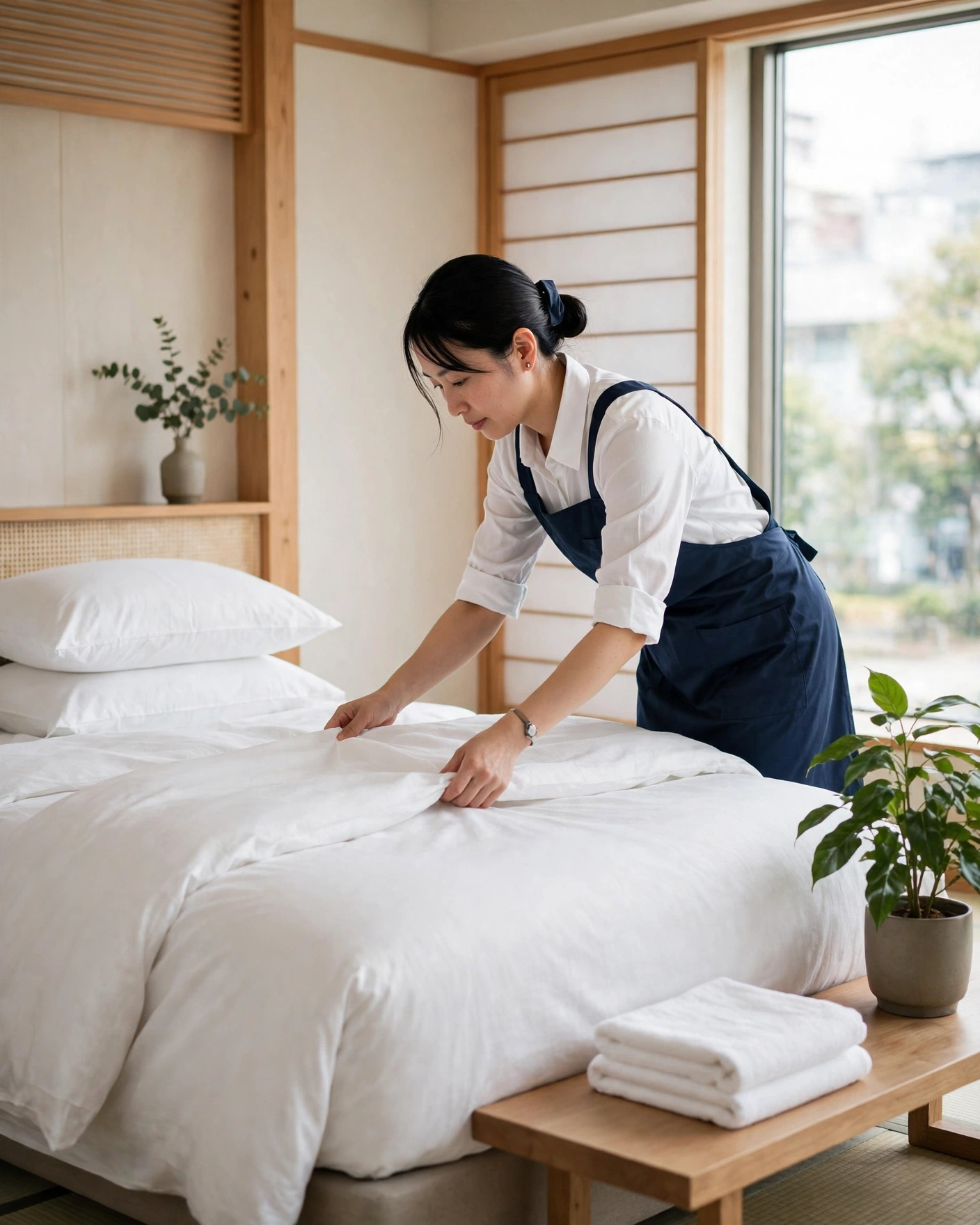
A housekeeping job in Japan starts with a list of rooms. First, your supervisor hands you the day’s rooms, and you work through them one by one. Next, strip the bed, change the sheets, remake it tightly, and smooth the cover. Then, clean the bathroom, replace the towels and toiletries, wipe the surfaces, and check the mirror. After that, vacuum or mop the floor, dust the furniture, empty the bins, and check the lights and the air conditioning. Before you leave, stand at the door and look back. A good housekeeper spots what a guest would spot.
Rooms differ in size and standard. A business hotel room is small and fast, and you may clean fifteen or more in a shift. A luxury hotel room is larger, with more detail, and you may clean fewer. A traditional ryokan has tatami floors, futon bedding, and a bath area that needs special care. Each setting has its own pace, and training teaches you the standard for that property.
Guests come first in Japanese hospitality. For example, you greet guests politely in the corridor, step aside to let them pass, and knock before entering a room. If a guest is inside, you ask before you start. Quiet, respectful behaviour earns trust fast. Supervisors watch how you treat guests as closely as how you clean a room.
Hotels and ryokan housekeeping, attention to detail, and working hours
City hotels and business hotels
City hotels in Tokyo, Osaka, Kyoto, and other big cities hire the most housekeepers. Business hotels serve travellers who stay one or two nights, so rooms turn over fast. In addition, check out is usually late morning, and check in starts in the afternoon. That window is the busiest part of the day, and teams work together to get rooms ready on time.
Ryokan housekeeping and why it is different
A ryokan is a traditional Japanese inn, often in a hot spring town or a scenic area. Housekeeping there follows customs that go back a long way. Tatami mats need gentle cleaning, never harsh chemicals. Futon bedding is laid out in the evening and put away in the morning. Bathrooms may include a private open air bath that needs careful scrubbing. Guests wear yukata robes, and rooms are kept calm and simple.
Ryokan work often includes serving meals or helping with guest requests, so the role can be broader than a city hotel. In fact, the pace is slower, the team is smaller, and the standard is personal. Guests remember the person who prepared their room. If you like quiet places, nature, and traditional culture, a ryokan can be a good fit. If you prefer a big city and a large team, a hotel suits you better.
Attention to detail is the whole job
Japanese housekeeping is famous for detail, and the detail is real. Every bed must meet the same standard each time, with the same fold and the same tuck. The bathroom mirror must be spotless. Inside and out, the kettle must be clean. Finally, the remote control must sit straight. Supervisors check rooms after you finish, and they notice what you missed.
Working hours and the daily rhythm
Housekeeping shifts usually start in the morning, often around 9 or 10, and run until the rooms are done, often mid to late afternoon. Some hotels run an evening turndown shift. However, night shifts are rare in housekeeping, which suits people who prefer daytime work. Rest days are usually one or two days a week, and the roster is set in advance.
Where to find real housekeeping listings in Japan
Hello Work, the public employment service run by the Japanese government, lists housekeeping jobs across the country. In addition, its offices help job seekers in person, and its online portal lets you search by region and job type. Listings there carry employer details, and the service itself is free.
Indeed Japan is the other place worth your time. It gathers listings from hotels, ryokan, and staffing agencies in one search. Moreover, use the Japanese term for housekeeping alongside English terms, because many listings are written in Japanese. Filter by region, shift, and employment type, and read the full listing before you apply. A real listing names the employer or the agency, describes the work, and states the pay in plain terms.
Staffing agencies place many housekeepers in Japan, especially in resorts and large hotel chains. A genuine agency never charges you a fee for finding work. It earns its money from the hotel, not from you. Check the agency name, search for reviews, and ask for the hotel name and address before you agree to anything. If an agency hides the hotel name or rushes you to pay, walk away.
Hotel career pages are worth a look too. Big hotel groups post openings on their own sites, and some run their own hiring for foreign workers. Local job boards in the city where you want to live can also help, especially for ryokan in smaller towns.
What employers usually ask for
Most housekeeping jobs Japan listings ask for a few simple things. You should be at least 18 years old and fit enough to walk, bend, and lift through a full shift. You should be able to follow a checklist and work as part of a team. Experience helps, but many hotels train beginners from zero.
Basic Japanese helps a lot. You need enough to understand your supervisor, read a room list, and greet guests politely. Some listings ask for a Japanese Language Proficiency Test level, often N5 or N4 for entry roles. Higher levels open up better roles and guest facing work. For example, learning the key words for cleaning, rooms, and polite greetings before you arrive gives you a real head start.
How pay is described for housekeeping jobs in Japan
Pay for housekeeping jobs Japan is usually quoted per hour. The listing shows an hourly rate, and your monthly pay depends on how many hours you work. Some listings quote a monthly figure instead, which normally reflects a standard month of full time hours. Read the listing carefully to see which one it uses.
Deductions come out of your pay for tax, health insurance, pension, and employment insurance. Therefore, your employer should explain these in writing before you start. Some hotels provide a staff meal during the shift, and some offer a dormitory or housing support in resort areas. The cost may be taken from your pay, so ask for the exact amount in writing, and check what it covers.
Compare listings on the hourly rate, the shift pattern, and the total hours, not on a headline monthly figure alone. For example, a high monthly figure built on long hours every week is not the same as a solid base rate with reasonable hours.
The visa question, honestly
Housekeeping work in Japan usually needs a work visa, and the type depends on your situation. The Specified Skilled Worker visa covers accommodation and food service in some cases, which can include hotel housekeeping roles. It has language and skills tests, and it is tied to a specific employer and sector. The Technical Intern Training Program is a different route, run through sending organisations and host companies in your home country. It is a training route, not a free choice of employer, and its rules are strict.
Some people already in Japan hold visas that allow work, such as a spouse visa or a long term resident visa. Others come on a student visa and work part time within the hours their visa allows. Each visa has its own limits, and the wrong visa for the wrong job can cause real trouble.
No agent can guarantee you a visa. Only the Japanese immigration authorities decide. Check the visa conditions on the official immigration website before you apply or pay for anything. A genuine employer or agency explains the visa route in plain terms and gives you time to check it yourself. Anyone who promises a visa for a fee is selling you a story, not a job.
How to apply
Step 1: Choose the setting that fits you
For instance, city hotels offer fast pace and steady work. Luxury hotels offer detail and training. Ryokan offer tradition, quiet places, and a broader role. Pick one setting and focus your search there, because the skills and the rhythm differ.
Step 2: Search Hello Work and Indeed Japan every week
Set up searches on both portals and check them on a fixed day each week. Save the listings that fit your level of Japanese, your location, and your shift preference. Read each listing in full before you apply, including the small print about shifts and deductions.
Step 3: Prepare a simple, honest resume
Write a short resume in Japanese if you can, or in English with a Japanese summary. List your work history, your Japanese level, and any hotel or cleaning experience. Keep it to one or two pages. A photo is common on Japanese resumes, so follow the listing if it asks for one.
Step 4: Apply through the listing, not through a stranger
Use the apply button on Hello Work, Indeed Japan, or the hotel career page. Keep a note of every place you applied, the date, and the contact name. This simple record saves you from confusion later and shows employers you are organised.
Step 5: Prepare for the interview and the room check
Interviews for housekeeping jobs Japan are often short and practical. Expect questions about your Japanese level, your health, your shift availability, and why you want housekeeping work. Some employers add a simple practical test, such as making a bed or cleaning a bathroom. Dress neatly, arrive early, and bring your documents. Ask about the shift pattern, the training, and the pay in writing.
What to avoid
Never pay for a job offer. No genuine hotel, ryokan, agency, or employer in Japan charges you to hire you. For example, fees for a visa, a medical check, or training should be explained in writing, and you should be able to check them against official sources. As a result, a demand for cash upfront is a red flag, and you should stop there.
Avoid listings that hide the employer name, the hotel location, or the pay. A real job has a real address. Avoid promises of very high pay for very light work. Housekeeping is honest, physical work, and the pay reflects that. A listing that sounds too good to be true usually is.
Avoid signing a contract you cannot read. Ask for a translation or take time to get help reading it. Check the pay, the hours, the shift pattern, the deductions, and the notice period. Never sign under pressure. A genuine employer gives you time.
Avoid agents who promise to move you between employers or change your visa type for a fee. Visa rules are set by the government, not by agents. If something feels rushed or secret, step back and check the official immigration website.
FAQ
Do I need to speak Japanese for housekeeping jobs Japan?
You need basic Japanese for most roles, enough to follow your supervisor, read a room list, and greet guests politely. Many listings ask for N5 or N4 level. Learning the key words for cleaning and polite greetings before you arrive helps a lot, and workers who keep studying get better roles over time.
Can foreigners work in Japanese hotels?
Yes, foreigners work in Japanese hotels through the Specified Skilled Worker visa, the Technical Intern Training Program, and other visas that allow work. Each route has its own rules and tests. Check the official immigration website to see which route fits your situation.
How many rooms do housekeepers clean in a day?
It depends on the hotel. A business hotel housekeeper may clean fifteen or more small rooms in a shift. A luxury hotel housekeeper may clean fewer, larger rooms with more detail. Your listing or interview should give you a sense of the daily target, so ask before you accept.
Is housekeeping work in Japan hard?
Housekeeping is physical and detailed rather than extreme. Walking, bending, lifting linen, and keeping pace with check out times are the main challenges. Training is usually provided, and most new workers settle in within a few weeks.
Do Japanese hotels provide housing for housekeepers?
Some hotels, especially ryokan and resorts outside the big cities, offer a dormitory or staff housing, and the cost may come out of your pay. City hotels usually expect you to find your own place. Ask for the housing details in writing before you accept an offer, including the monthly cost and what it covers.
Related guides
Job804 shares job information and practical guides. Job804 is not an employer, not a recruitment agent, and does not guarantee a job, an interview, or a visa. Always check the live listing on Seek, Indeed, or the employer official website, and check visa conditions on the official immigration website before you apply or pay for anything. Never pay for a job offer.
Last checked: 27 November 2026. Check the live listing before you apply.
