
Introduction
Warehouse jobs Japan offer steady, year round work in one of the most organised logistics sectors in the world.
Japan moves a huge volume of goods through distribution centres, e-commerce fulfilment sites and factory warehouses. Employers in Tokyo, Osaka, Nagoya and Fukuoka hire pickers, packers, forklift drivers and sorters all year.
The work follows a clear structure. The rules stay clear and the pay arrives on time. That appeals to people who want stability abroad.
This guide explains what warehouse work in Japan really involves. It covers automation and picking systems, how much Japanese you need, how pay is usually described and how the visa side works.
You will also find where real listings appear. The guide gives a step by step way to apply and the warning signs to watch for.
It helps someone planning from outside Japan as well as someone already living there. This work suits people who are reliable, careful with detail and comfortable on their feet for a full shift.
Warehouse jobs Japan: what the work actually looks like
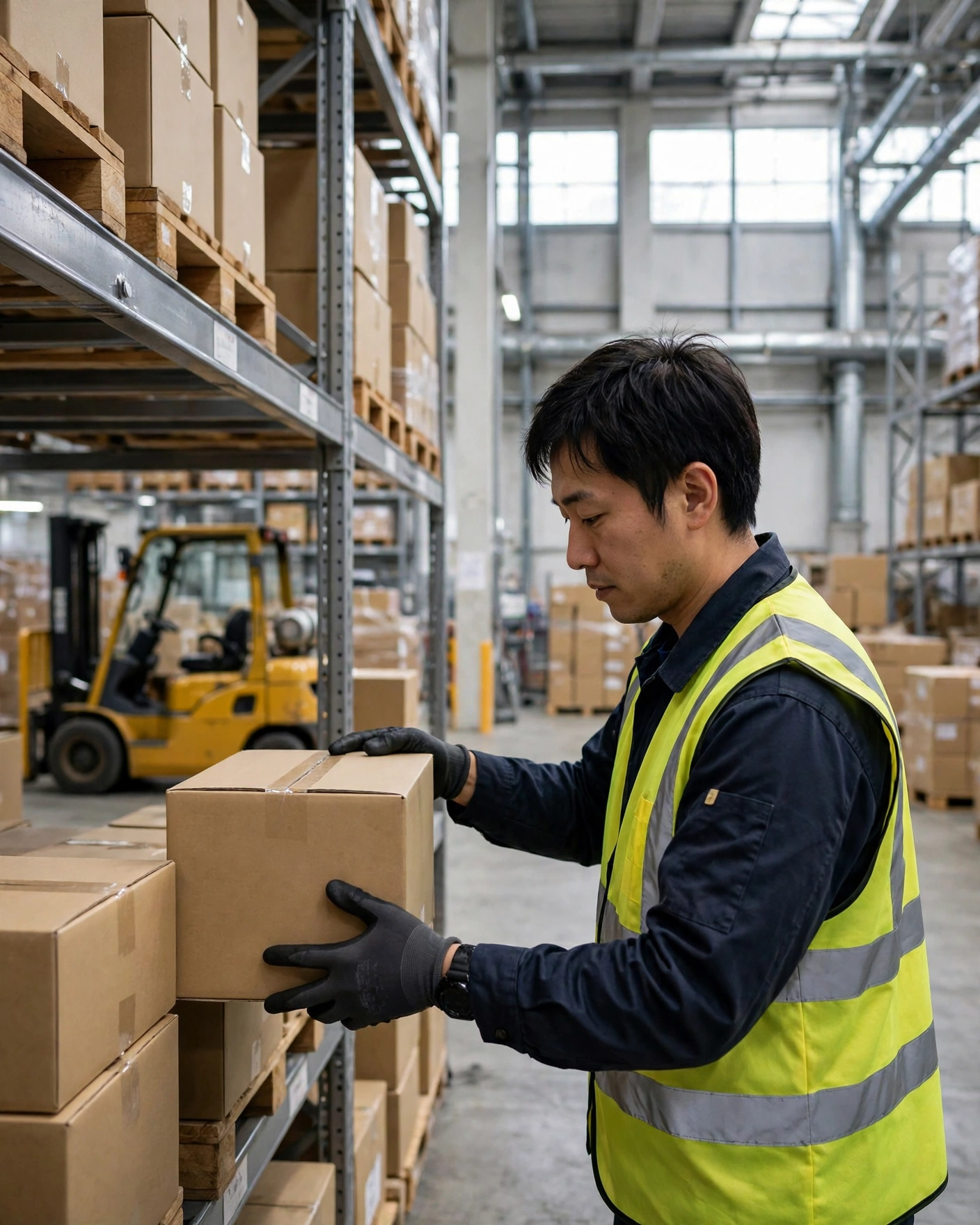
Warehouse jobs Japan usually mean picking, packing, sorting or loading goods inside a large distribution centre. A picker collects items from shelves against an order list, and a packer boxes them and labels them for dispatch. A sorter separates incoming goods onto the right conveyor or shelf.
Every role follows a clear process, and supervisors measure speed and accuracy against a daily target.
Most shifts last eight hours, with day shifts starting in the morning and night shifts running through the evening. Weekend work is common in e-commerce warehouses, because online orders keep coming seven days a week. You will be on your feet most of the day, walking between aisles, lifting boxes and scanning barcodes.
The weight is usually manageable. Staff move heavier items by trolley, pallet jack or forklift rather than by hand.
Order and cleanliness define Japanese warehouses. Staff mark the floors, label the shelves and give every item a fixed place.
New starters get an induction that covers safety, the scanning system and the layout of the site. A team leader shows you the process before you work alone.
Employers take punctuality seriously. Arriving a few minutes early is the norm.
Warehouse automation, picking systems and the language question
Automation is the feature that sets warehouse jobs Japan apart from warehouse work elsewhere. Many large Japanese distribution centres use conveyor belts, automated storage and retrieval systems, and robots that carry shelves to pickers.
Goods to person systems bring the shelf to you. You pick from a screen prompt rather than walking the aisles.
Barcode scanners and handheld terminals guide every pick. The system checks your work as you go, which cuts errors and keeps the flow fast.
Voice picking is common too. You wear a headset, and the system tells you where to go and how many items to pick. You confirm each pick by voice.
Digital picking uses lights on the shelf to show you the item and the quantity. You need to be comfortable with a handheld device or a screen, and you need to follow prompts exactly.
Language is the question every applicant asks, and the honest answer is that some Japanese helps a lot.
Many warehouses ask for basic conversational Japanese, around N4 or N3 level. Safety instructions, team briefings and labels are in Japanese.
Some large logistics employers hire English speakers for specific sites, especially around Tokyo and Osaka, and some use multilingual supervisors.
Where to find real warehouse jobs Japan listings
Real warehouse jobs Japan appear on Indeed Japan, Daijob and GaijinPot Jobs. Those three sites should be your starting point.
Search for “warehouse”, “logistics” or “picker packer” and filter by city. Use Tokyo, Osaka, Nagoya or Fukuoka as your location.
Listings from large logistics companies appear here regularly. They usually name the employer, the site type, the shift pattern and the language level required.
Company career pages are the next place to look. Big Japanese logistics firms like Yamato, Sagawa, Nippon Express and Amazon Japan advertise on their own sites. Applying there puts your application in front of the recruiter directly.
Read the job ad fully before you apply. The first lines usually state the language level and the visa status.
Treat social media posts about warehouse jobs with care. Ask for the company name, the site address and a written offer. Do this before you share personal documents with anyone.
What employers usually ask for
Most warehouse jobs Japan ask for very little in the way of formal qualifications, and that is part of their appeal. Employers want people who are physically fit, reliable and able to follow a process exactly.
You need to be able to stand and walk for a full shift. You also need to lift boxes up to a reasonable weight and repeat careful movements without losing concentration.
Previous warehouse or factory work helps, but many sites train complete beginners.
A valid visa that allows work in Japan is the first requirement. Employers will check it before your first shift.
Employers will ask to see your residence card, and they will keep a copy on file.
Basic Japanese is the usual language ask, around N4 or N3 level, though some sites accept English speakers. A forklift licence is a plus for driver posts, and some employers pay for the training. Reliability counts for more than speed in the first week. Turning up on time, every day, and telling your team leader early if you are sick builds trust fast.
Pay: how it is usually described
Listings usually describe pay for warehouse jobs Japan as an hourly rate. They should show the rate or the monthly figure.
Japan has a minimum wage that varies by prefecture, and Tokyo and Osaka pay more than rural areas. Large logistics companies often pay above the local minimum, and night shifts usually carry a higher rate. Your exact rate depends on the region, the shift, your experience and whether you hold a forklift licence.
Base pay is the core figure, while allowances for night work, transport and overtime sit on top.
Transport allowance is common in Japan. The employer usually pays your train fare to the site up to a monthly limit.
The employment contract should state the overtime rules, the shift pattern and the pay date, which is usually once a month. Check your payslip each month against your roster, and keep your own note of the shifts you worked. A written contract is standard, and you should read it fully, with a translation if needed, before you sign.
The visa question, honestly
The visa question for warehouse jobs Japan is the part that needs the most honest answer. Citizens of other countries need a visa that allows work in Japan before they start. A tourist visa on its own does not allow that.
Warehouse work is not on the fast track lists for highly skilled jobs. The route is narrower than for engineers or nurses, but it is not closed.
Most applicants take a work visa tied to a specific job offer from a Japanese employer. The employer sponsors the application. Processing takes time, often two to four months, so start early and keep every document organised.
Young people from a list of countries can get a working holiday visa. It allows warehouse work during your stay in Japan.
Check the age limit and conditions for your own country on the website of the Japanese embassy in your country. Never pay an agent who promises a guaranteed visa or a guaranteed warehouse job for a fee.
How to apply for warehouse jobs Japan
Applying for warehouse jobs Japan works best when you prepare your visa status and your language first. Then apply to real companies.
A short, honest application sent to a named employer beats a dozen messages sent to strangers on social media.
Step 1: Check your visa and your Japanese level
Confirm that your visa allows work in Japan and that it covers the period you plan to work. Check your Japanese level honestly against N4 or N3, and start learning basic workplace words if you have not already. Gather your passport, your residence card if you live in Japan and any certificates you hold.
Step 2: Search Indeed Japan, Daijob and GaijinPot
Search Indeed Japan, Daijob and GaijinPot Jobs for warehouse, logistics and picker packer roles in your chosen city. Save listings that name a real employer, a site type and a shift pattern. Look at the company career pages of large logistics firms as well as the job boards.
Step 3: Prepare a simple CV and cover note
Write a one page CV. List your work history, any warehouse or factory experience, your Japanese level and any forklift licence you hold.
Add a short cover note. Say when you can start, which shifts you can work and where you are based.
Step 4: Apply and confirm the details in writing
Apply through the listing or the company career page. When an offer comes, ask for the details in writing before you accept. Ask about the employment contract, the hourly rate, the shift pattern, the site location and any transport allowance.
A real employer will send these without hesitation.
Step 5: Attend induction and learn the systems
Take the site induction seriously. Learn the scanning system, the picking process and the safety rules before your first solo shift.
Ask questions when anything is unclear, and watch how experienced pickers work. Accuracy matters more than speed at the start.
What to avoid when you apply
The biggest risk with warehouse jobs Japan is not the work itself. It is the people who exploit job seekers around it.
Never pay for a job offer, a visa arrangement or a guaranteed place at a warehouse for a fee. Real logistics companies do not charge workers to get hired, and any fee for a job is a warning sign. Report the post and move on.
Be careful with listings that promise very high pay with no experience, no Japanese and no visa needed. Those three promises together are almost always false, because the visa and the language are real requirements.
Never hand over your passport or your residence card to an employer, an agent or a middleman. Employers may need to sight your documents and take a copy for their records, and that is normal. Keeping the originals yourself is also normal. Avoid anyone who insists on holding them.
A typical week and living costs
A typical week of warehouse jobs Japan runs for five days. Shifts last eight hours, and a roster covers weekends in e-commerce sites.
A picker on a day shift starts in the morning and finishes in the afternoon. A night shift worker sleeps during the day. Days off fall on set weekdays, and the roster rarely changes, which makes it easy to plan your life around work.
Living costs depend on the city. Tokyo and Osaka are expensive for rent, while Nagoya and Fukuoka are cheaper. Shared houses and small apartments are the common choices, and many workers live near a train station for an easy commute. Cooking your own meals and using a commuter train pass keep weekly costs down.
Your first pay usually arrives at the end of your first month. Bring enough savings to cover rent, food and transport until then.
Frequently asked questions
Do I need Japanese for warehouse jobs in Japan?
Many warehouses ask for basic conversational Japanese, around N4 or N3 level. Safety instructions, team briefings and labels are in Japanese.
Some large logistics employers hire English speakers for specific sites, especially around Tokyo and Osaka.
What does warehouse automation mean for pickers?
Automation changes how you pick, not whether employers need pickers.
Conveyors, robots and goods to person systems bring shelves to you. Scanners, headsets and pick to light systems guide each pick.
Employers train you on the job, and training takes a few days.
How much can I earn in a warehouse job in Japan?
Pay is usually hourly. The live listing or the employment contract shows the exact rate.
Your rate depends on the region, the shift, your experience and whether you hold a forklift licence. Night shifts usually pay more, and transport and overtime allowances sit on top of base pay.
Can I do warehouse work in Japan on a working holiday visa?
Yes, a working holiday visa allows you to work in Japan. Warehouse work is a common choice for working holiday makers.
Check the age limit and conditions for your own country on the Japanese embassy website, because these change by nationality.
Where do warehouse workers live in Japan?
Most warehouse workers live in shared houses or small apartments near a train station. Many employers help with finding a place.
Some large logistics companies run their own dormitories or offer housing support.
Related guides
- Truck Driver Jobs in Canada 2026
- Carpenter Jobs in Australia 2026
- Kitchen Helper Jobs in Australia 2026
Job804 shares job information and practical guides. Job804 is not an employer, not a recruitment agent, and does not guarantee a job, an interview, or a visa.
Always check the live listing on Seek, Indeed, or the employer official website. Check visa conditions on the official immigration website before you apply or pay for anything. Never pay for a job offer.
Last checked: 29 November 2026. Check the live listing before you apply.
